
How To Install Ceiling Insulation Correctly
Most ceiling insulation advice online is based on European and American homes — and that’s where the problem starts. This is 36 years of experience in How to Install Ceiling Insulation.
South African roof structures are completely different.
With over 36 years of hands-on experience, supplying and installing Ceiling insulation across homes, factories, and industrial plants like Koeberg, SAPREF, Engen, and major KZN sugar mills — we’ve seen exactly what works… and what fails.
The truth is simple:
Most insulation installations in South Africa are done incorrectly.
And that’s why many homeowners see little to no improvement.
This guide will show you how to install ceiling insulation properly — and where most installers get it wrong.
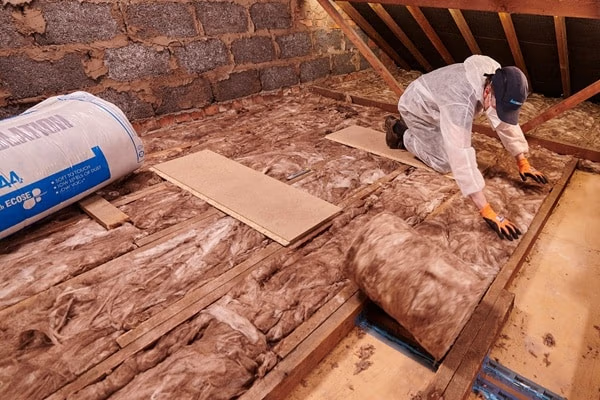
Why Most Ceiling Insulation Installations Fail in South Africa
The biggest mistake comes from copying overseas methods. Homes in the USA, for example, have accurate measurements between beams. In South Africa, the gap may vary by up to 80% from one line to the next. This is why it is important to add 100mm of ceiling insulation between the beams.
In countries like the USA and Europe:
- Rafters are evenly spaced
- Insulation batts fit perfectly (400mm / 600mm)
- No cutting required
That does NOT apply in South Africa.
Here:
- Beam spacing varies from 600mm to 1300mm
- Gaps are inconsistent
- Installers force standard sizes into uneven spaces
Result:
❌ Gaps
❌ Poor thermal performance
❌ Wasted money
The Biggest Mistake — Air Gaps in Insulation
This is where most jobs fail.
When insulation does not fit tightly:
- Air moves freely
- Heat bypasses the insulation
- Cold penetrates the ceiling
Your insulation becomes almost useless.
Why does this happen?
Above your ceiling:
- Timber battens (38mm – 50mm thick) act as heat channels
- Gaps allow heat to move underneath the insulation
This dramatically increases heat transfer into the home
The Correct Way How To Install Ceiling Insulation (Professional Method)
This is where your experience becomes gold.
✅ 1: Measure Every Gap (Not Guessing)
No two sections are the same.
👉 Proper installation requires:
- Measuring each section
- Adjusting insulation width accordingly
✅ 2: Cut Insulation Wider (CRITICAL)
At Cape Ceilings & Drywalling, we:
👉 Cut insulation 100mm wider than the beam spacing
Example:
- Gap = 750mm
- Insulation cut = 850mm
Why this works:
- Creates a tight friction fit
- Eliminates air gaps
- Prevents heat bypass
✅ 3: Install With a Tight Fit (No Sagging, No Gaps)
Each section must:
- Sit snugly between beams
- Have no visible gaps
- Not be compressed too tightly
👉 The goal is full coverage without airflow
✅ 4: Allow for Variations in Roof Structure
South African roofs are inconsistent.
👉 Your installation must adapt:
- Uneven spacing
- Warped timber
- Old structures
This is where experience matters.
✅ 5: Use More Material Than the Floor Plan
We typically use:
👉 10% more insulation than the measured area
Why?
- Covers irregular gaps
- Prevents weak spots
- Ensures a complete thermal barrier
Expected Results From Proper Installation
When installed correctly, you should see:
✅ 4°C to 8°C temperature improvement
✅ Reduced heating and cooling costs
✅ More stable indoor temperature
✅ Improved comfort year-round
Why We Do NOT Install Cellulose Insulation
This is a strong positioning move — keep it.
Due to coastal conditions in South Africa:
❌ Cellulose absorbs moisture
❌ Risk of settling and gaps
❌ Reduced long-term performance
👉 We only install proven materials:
The Reality — Anyone Can Install Insulation (But Few Do It Properly)
Let’s be blunt (this is good for conversions):
The insulation industry in South Africa is flooded with:
- Untrained installers
- Cheap labour
- Poor workmanship
👉 Most don’t understand:
- Heat transfer
- Air movement
- Proper fitting techniques
And homeowners pay the price.
Why Experience Matters (36+ Years) On How To Install Ceiling Insulation Correctly
This is your killer section.
We have:
- Installed insulation in thousands of homes
- Supplied industrial insulation to:
- Koeberg Power Station
- SAPREF Refinery
- Engen Refinery
- KZN Sugar Mills
- Food processing plants
👉 We understand insulation from:
- Domestic applications
- Industrial thermal systems
- High-performance environments
That level of experience is rare.
DIY vs Professional Installation
DIY:
- Usually leaves gaps
- Incorrect sizing
- Poor performance
Professional:
- Measured and fitted correctly
- No air gaps
- Maximum efficiency
👉 Insulation only works if installed correctly.
Get Your Ceiling Insulation Installed Properly
If you want insulation that actually works:
👉 It must be installed correctly from the start.
Request a Quote
View Installation Services
❓ FAQ SECTION (VERY IMPORTANT FOR SEO)
How much difference does ceiling insulation make?
Properly installed insulation can improve indoor temperatures by 4°C to 8°C.
Why are gaps in insulation a problem?
Gaps allow hot or cold air to bypass the insulation, reducing its effectiveness.
Can I install insulation myself?
You can, but poor installation often leads to reduced performance.
What insulation is best for South African homes?
Aerolite, Knauf, Isotherm, and Factorylite are all proven options.
Why is the insulation cut wider than the gap?
To ensure a tight fit and eliminate air gaps.