
Aerolite Insulation vs Isotherm Insulation: Which Is Better for Your Home?
An Honest South African Comparison Based on 36 Years of Insulation Experience
Choosing between Aerolite Insulation vs Isotherm Insulation can be confusing because both products are sold as effective ceiling insulation for South African homes. Both reduce heat transfer, improve indoor comfort and help lower the amount of energy needed for heating and cooling. However, they are made from different materials and differ in fire performance, handling, acoustic control, and value for money.
The short answer is this: 135mm Aerolite and 145mm Isotherm offer almost identical thermal performance when correctly installed. Aerolite is our preferred overall option because it is non-combustible, has excellent acoustic properties, offers consistent published specifications and is normally more cost-effective per square metre.
Isotherm remains a practical alternative for homeowners who place a high value on soft, non-itch handling, particularly for DIY installation. It is important, however, to understand that Isotherm’s fire classification is not the same as Aerolite’s non-combustible A1 classification.
After more than 36 years of supplying and installing insulation in South African homes, commercial buildings and industrial facilities, we believe the correct choice should be based on verified performance—not advertising claims or the colour of the roll.
Recommended buttons below the introduction:
Quick Verdict: Is Aerolite or Isotherm Better?
For most South African homes, Aerolite is the better all-round choice.
- Best overall: Aerolite
- Best thermal performance: Effectively a draw at 135mm Aerolite versus 145mm Isotherm
- Best fire performance: Aerolite
- Best documented acoustic performance: Aerolite
- Easiest DIY handling: Isotherm
- Best value for money: Usually Aerolite
- Best choice for professional residential installation: Aerolite
This does not mean Isotherm is ineffective. A correctly installed 145mm Isotherm layer can deliver excellent thermal performance. The deciding differences are fire classification, handling, price and whether the product supplied consistently matches the specified thickness and density.
Aerolite Insulation vs Isotherm Insulation: Comparison Table
| Feature | Aerolite Insulation | Isotherm Insulation |
|---|---|---|
| Insulation material | Glasswool made partly from recycled glass | Thermally bonded polyester made from recycled PET |
| Leading residential thickness | 135mm | 145mm |
| Product R-value at leading thickness | R3.38 | R3.37 |
| Approximate total roof-and-ceiling system R-value | R3.78 | R3.77 |
| Published fire classification | A1 under SANS 53501-1; non-combustible | B/B 1/2 under SANS 428 |
| Standard thickness options | 50mm, 100mm and 135mm | 40mm, 50mm, 75mm, 100mm, 135mm and 145mm |
| Handling | Soft Touch glasswool; suitable PPE remains advisable | Soft, non-itch polyester and comfortable to handle |
| Acoustic performance | Excellent; 135mm Aerolite has a published NRC of 1.10 | Provides sound absorption, but compare like-for-like test data |
| Moisture | Non-hygroscopic, but roof leaks must still be repaired | Resistant to condensation and associated fungi, but must not be used to hide roof leaks |
| Typical value | Normally lower cost per square metre | Normally more expensive at the comparable high-performance thickness |
| Our overall recommendation | Best choice for most homes | Useful where comfortable DIY handling is the priority |
Important: The R-value of the insulation product and the total R-value of the complete roof-and-ceiling assembly are not the same measurement. Always compare product with product or complete system with complete system.
What Is Aerolite Insulation?
Aerolite insulation is a flexible glasswool ceiling insulation manufactured by Isover. It traps air within millions of fine glass fibres, slowing the movement of heat through the ceiling. This helps keep a home cooler during hot weather and reduces heat loss during winter.
Modern Aerolite Soft Touch is softer and produces less dust than older generations of fibreglass insulation. It is supplied in compression-packed rolls and recovers to its intended thickness after opening. The manufacturer advises allowing approximately 24 to 48 hours for full recovery.
The three standard Aerolite thicknesses have the following published product R-values:
| Aerolite thickness | Roll dimensions | Coverage | Product R-value |
|---|---|---|---|
| 50mm | 10m × 1.2m | 12m² | R1.14 |
| 100mm | 6m × 1.2m | 7.2m² | R2.50 |
| 135mm | 5m × 1.2m | 6m² | R3.38 |
For most new homes and substantial insulation upgrades in Cape Town, Johannesburg, Pretoria and other cooler South African regions, 135mm Aerolite is the important comparison product. The 50mm roll is generally used as a top-up layer rather than as the only insulation in a previously uninsulated ceiling.
Aerolite’s principal advantages are:
- Non-combustible A1 fire classification
- Strong thermal performance at 135mm
- Published NRC of 1.10 for the 135mm product
- Long service life when correctly installed and kept in good condition
- No food value for rodents or insects
- Wide availability and competitive cost per square metre
- Suitable for new homes, retrofits and top-up applications
What Is Isotherm Insulation?
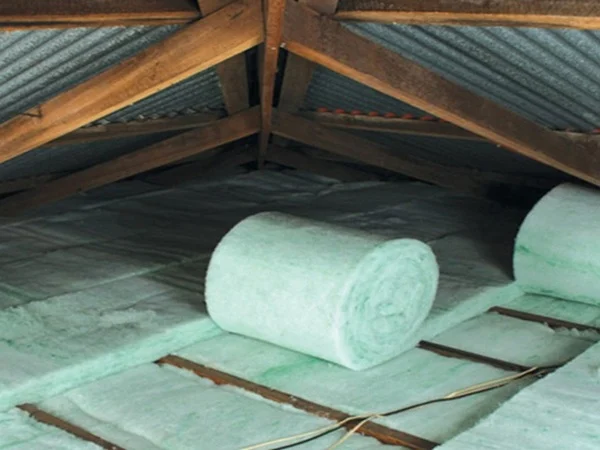
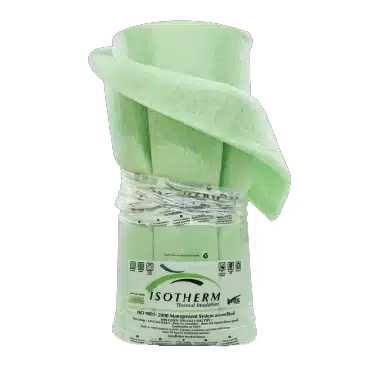
Isotherm insulation is manufactured from thermally bonded polyester fibres produced from recycled PET plastic. The fibre structure traps air and reduces heat transfer through ceilings, walls and other building elements.
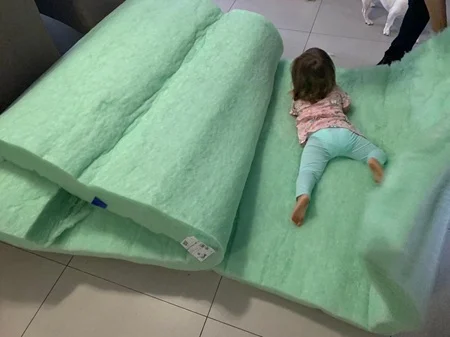
Its best-known practical advantage is handling. Isotherm is soft, does not contain glass fibres and is generally more comfortable for homeowners to cut and install themselves. This has made it popular for DIY ceiling upgrades and homes where the installer is particularly sensitive to fibrous dust.
Isotherm is available in more thickness and density combinations than Aerolite. This is useful, but it also means buyers must check more than the thickness printed on the pack. For example, the manufacturer’s published specifications include two different 100mm products:
- 100mm at 8.5kg/m³ with a product R-value of R1.57
- 100mm at 11.5kg/m³ with a product R-value of R2.33
They are both 100mm thick, but they do not offer the same thermal performance. Thickness alone does not determine the R-value; density and thermal conductivity matter, too.
The 145mm Isotherm product has a published product R-value of R3.37 and a total roof-and-ceiling assembly R-value of R3.77. It is therefore the correct Isotherm product to compare with 135mm Aerolite.
Isotherm’s main advantages are:
- Soft and comfortable to handle
- Made from recycled PET fibres
- Available in several thicknesses and widths
- Good thermal performance at the correct density and thickness
- Resistant to condensation and associated fungi and bacteria
- Suitable for professional or DIY installation
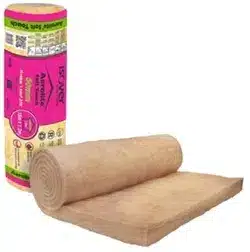
Thermal Performance: 135mm Aerolite vs 145mm Isotherm
R-value measures resistance to heat flow. The higher the R-value, the greater the resistance to heat moving through the material or building system.
The fairest comparison is:
- 135mm Aerolite: product R-value R3.38
- 145mm Isotherm: product R-value R3.37
The difference is only R0.01 and will not produce a noticeable comfort difference in a normal home. When the common roof-and-ceiling assembly contribution is included, the totals are approximately R3.78 for Aerolite and R3.77 for Isotherm.
Thermally, this is effectively a draw.
The more important question is whether the insulation has been installed at its full designed thickness with complete, continuous coverage. A nominally high R-value product will underperform when it is compressed, pulled apart too thinly, left short of external wall plates or fitted with gaps around beams, pipes and ceiling penetrations.
In real South African roofs, truss and beam spacing is rarely as uniform as overseas installation diagrams suggest. Gaps may vary from approximately 600mm to 1,300mm, with about 750mm being common in many homes. Rolls must therefore be measured and cut to fit the actual space. Installation quality can make a larger difference than the tiny R0.01 difference between these two leading products.
Read our guide to installing ceiling insulation correctly before attempting a DIY installation.
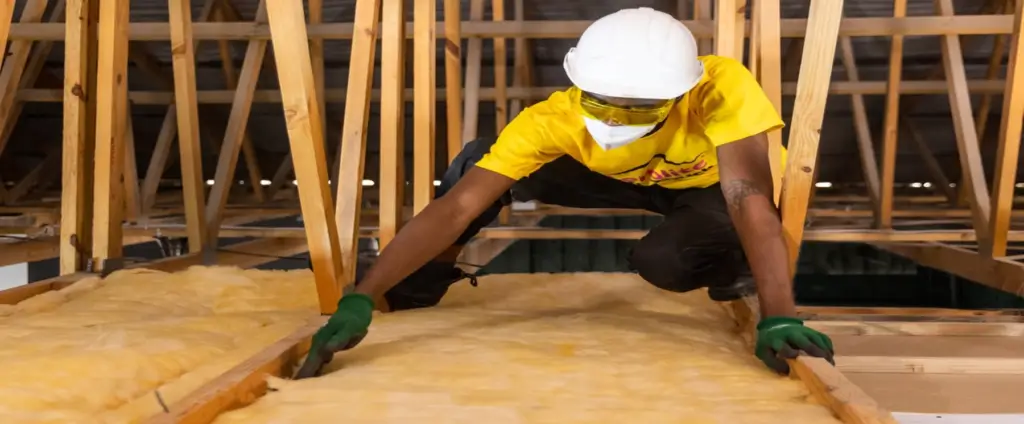
Fire Safety: The Most Important Difference
Fire performance is where Aerolite and Isotherm are not equal.
Aerolite Soft Touch is classified A1 under SANS 53501-1 and is non-combustible. The manufacturer’s technical information also lists an A/A1/1 classification under SANS 428 and states that the product does not burn or spread fire.
Isotherm’s published fire performance classification is B/B 1/2 under SANS 428. Its manufacturer also reports nil spread of flame under ASTM E84 and states that it does not smoulder under BS 5803 Part 4.
Those are meaningful performance claims, but a B/B 1/2 classification is not the same as an A1 non-combustible classification. For homeowners who place fire safety first, Aerolite has the clearer advantage.
This distinction matters around electrical wiring, downlights, transformers, junction boxes and other potential heat sources. Regardless of which insulation is selected, the installer must maintain the required clearances around non-IC-rated recessed lights and follow the fitting manufacturer’s instructions. Insulation should not be used to conceal unsafe wiring or faulty electrical components.
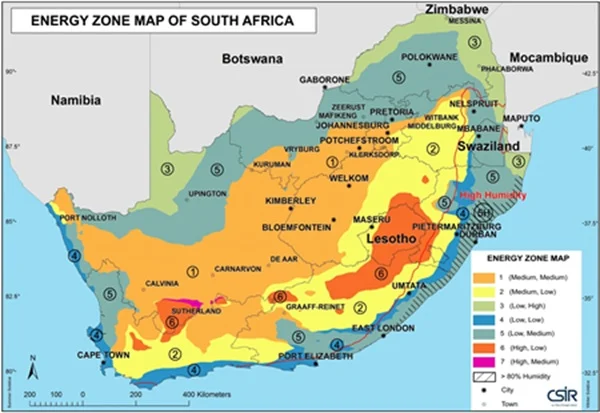
Real-World Product Consistency and Installed Performance
An insulation product only delivers its rated performance when the material in the roof matches the tested specification.
Based on our own supply and installation experience, we have occasionally found Isotherm rolls that appeared lighter or less dense than expected. In some checks, measured roll weight was up to approximately 15% below the expected weight. This is an observation from our own product handling, not a claim that every Isotherm roll is underweight.
It is nevertheless one reason we recommend checking:
- The product name and density on the pack
- The specified roll length, width and coverage
- Whether the roll recovers to its stated thickness
- Whether the installer stretches the material to cover more area
- Whether the completed ceiling has gaps or thin sections
Aerolite must also be allowed to recover after being compression packed. It should never be flattened beneath stored items or squeezed into an unsuitable cavity. Neither product can deliver its tested R-value when installed at less than its specified thickness.
Select the image for the YouTube Video on how to cut and install the Insulation
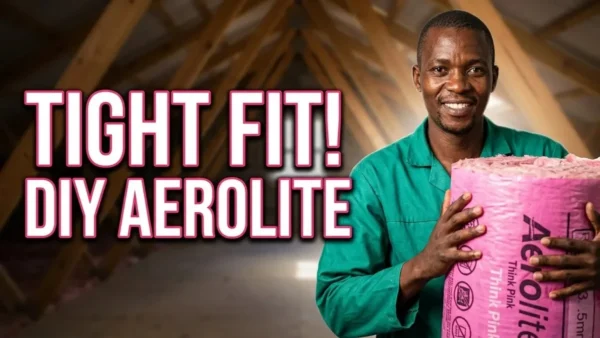
Which Product Is Easier to Install?
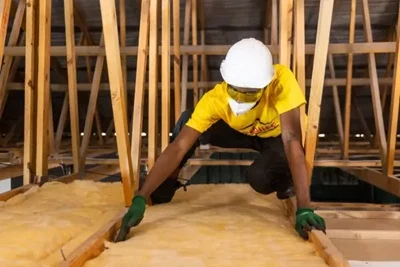
Aerolite Insulation vs Isotherm Insulation: which one wins the handling comparison? Its polyester fibres are soft and generally non-irritating, making it the easier product for DIY users to carry, cut and position.
Aerolite Soft Touch is considerably more comfortable to work with than older fibreglass products, but sensible protective equipment is still recommended:
- Long sleeves and long trousers
- Gloves
- Eye protection
- A suitable dust mask
- Knee protection and safe roof-space access equipment
The easier product to touch is not automatically the better installed product. Roof access, electrical hazards, fragile ceilings, uneven beam spacing and low roof pitches make professional installation worthwhile in many homes.
Whichever material is used, it must:
- Cover the ceiling continuously from external wall to external wall.
- Fit neatly around beams, pipes and approved electrical clearances.
- Remain at its full designed thickness.
- Avoid unnecessary compression.
- Leave no exposed strips of ceiling between rolls.
- Be installed without blocking essential roof ventilation.
Acoustic Performance and Noise Reduction
Both products can help reduce airborne sound passing through the ceiling, but Aerolite has the stronger published acoustic case.
Isover’s technical data lists Noise Reduction Coefficients of:
- 50mm Aerolite: NRC 0.80
- 100mm Aerolite: NRC 1.00
- 135mm Aerolite: NRC 1.10
This makes 135mm Aerolite an attractive option for homes affected by traffic, aircraft, neighbourhood noise, wind or rain on the roof. Insulation alone will not soundproof a building, because noise can still travel through windows, doors, walls and structural gaps. It does, however, improve the sound absorption of the ceiling cavity.
Isotherm also absorbs sound, but any direct numerical comparison should use products tested at comparable thicknesses and under the same test method. Vague claims such as “excellent soundproofing” are not enough to establish which material performs better.
For applications where acoustic control is a major priority, speak to us about the complete ceiling system rather than selecting insulation by brand alone.
Moisture, Condensation and Roof Leaks
Marketing often presents polyester as the automatic winner in wet conditions, but that can be misleading. Ceiling insulation is not a waterproofing product, and no insulation should be expected to compensate for a leaking roof.
Aerolite is described by its manufacturer as non-hygroscopic and compatible with standard building materials. Isotherm is described as resistant to condensation and associated fungi and bacteria. Both products can perform reliably in a properly constructed, dry roof space.
If either product becomes soaked:
- Find and repair the source of the leak immediately.
- Do not trap moisture against timber, metal or ceiling boards.
- Allow the roof cavity and insulation to dry thoroughly.
- Replace damaged, contaminated or permanently compressed material.
Correct roof ventilation and vapour control are more important than choosing insulation on the assumption that future roof leaks are unavoidable.
Environmental Considerations
Both products make use of recycled material:
- Aerolite is manufactured using recycled glass.
- Isotherm uses polyester fibre produced from recycled PET bottles.
It is therefore too simplistic to declare one product environmentally superior based only on its raw material. A proper environmental comparison must also consider manufacturing energy, transport volume, verified environmental declarations, service life, replacement frequency and the energy the insulation saves while installed.
The greatest environmental benefit comes from choosing an appropriate R-value and installing the product correctly so it continues reducing heating and cooling demand for many years.
Aerolite Insulation vs Isotherm Insulation Price and Long-Term Value
Insulation prices change as manufacturers, transport costs and stock levels change. For this reason, compare the cost per square metre at equivalent thermal performance, not only the price per roll.
A 135mm Aerolite roll normally covers 6m². A 145mm Isotherm roll may be supplied in different widths, so its pack coverage must be checked before comparing prices. In our experience, Aerolite is generally the more economical option when both products are selected to deliver approximately R3.37 to R3.38.
The cheapest quotation is not always the best value. Confirm that it includes:
- The correct thickness and density
- Full ceiling coverage
- Cutting around beams and penetrations
- Safe treatment of downlights and electrical equipment
- Access and installation labour
- Removal or repositioning of unsuitable existing material, when necessary
- VAT and delivery
See our regularly updated ceiling insulation prices in South Africa or contact us for a current supply or installation quotation.
Which Insulation Should You Choose?
Choose Aerolite if:
- You want non-combustible ceiling insulation.
- Fire performance is a major consideration.
- You want excellent documented acoustic absorption.
- You want strong thermal performance at a competitive cost.
- The product will be fitted by experienced installers using suitable PPE.
- You want our preferred all-round option for a South African home.
Choose Isotherm if:
- Soft, non-itch handling is your main priority.
- You intend to complete a careful DIY installation.
- You specifically prefer polyester insulation made from recycled PET.
- You have checked the product density, R-value, roll weight and recovered thickness.
- You understand that its B/B 1/2 classification is not equivalent to A1 non-combustibility.
Our Recommendation
For most homes, we recommend 135mm Aerolite over 145mm Isotherm.
Their thermal performance is virtually identical, so the decision should be made on the differences that remain. Aerolite offers the stronger fire classification, excellent published acoustic performance, proven specifications and normally better value per square metre.
Isotherm is easier and more comfortable to handle, and a correctly specified 145mm product can insulate a ceiling effectively. We therefore continue to make it available where a customer specifically wants polyester insulation. It is simply not our first recommendation when the complete balance of thermal performance, fire safety, acoustic control and cost is considered.
If you are still uncertain, explore our guide to the best ceiling insulation in South Africa or ask us to assess your roof type, location and existing insulation.
Frequently Asked Questions
Is Aerolite better than Isotherm insulation?
For most homes, we consider Aerolite the better all-round product. At their leading residential thicknesses, Aerolite and Isotherm provide almost identical thermal resistance. Aerolite’s advantages are its non-combustible A1 fire classification, documented acoustic performance and normally lower cost per square metre. Isotherm’s principal advantage is softer, non-itch handling.
Which keeps a house cooler: Aerolite or Isotherm?
Correctly installed 135mm Aerolite and 145mm Isotherm should provide practically the same thermal result because their product R-values are R3.38 and R3.37 respectively. Complete coverage, recovered thickness and correct installation will matter more than the R0.01 difference.
Is Isotherm non-combustible?
No. Isotherm’s published classification is B/B 1/2 under SANS 428. Aerolite is classified A1 under SANS 53501-1 and is non-combustible. Isotherm has published fire-performance test results, but its classification should not be described as equivalent to A1 non-combustibility.
Does Aerolite insulation make you itch?
Glasswool can irritate exposed skin while it is being handled. Modern Aerolite Soft Touch is softer and produces less dust than older fibreglass products, but gloves, long clothing, eye protection and a suitable mask remain sensible during installation. Once properly installed above the ceiling and left undisturbed, normal occupants do not handle the material.
What is the R-value of Aerolite Insulation vs Isotherm Insulation?
The product R-value of 135mm Aerolite is R3.38. The product R-value of 145mm Isotherm is R3.37. When the roof-and-ceiling assembly contribution is included, the commonly stated totals are approximately R3.78 and R3.77 respectively.
What thickness of ceiling insulation should I install?
The correct thickness depends on your South African climatic zone, the roof-and-ceiling system and whether existing insulation is already present. For substantial residential upgrades in Cape Town, Johannesburg, Pretoria and similar regions, 135mm Aerolite or 145mm Isotherm are the relevant high-performance options. Do not select insulation by thickness alone; verify its actual R-value.
Can I install Aerolite or Isotherm myself?
Both can be installed as DIY products, but Isotherm is more comfortable to handle. Safe roof access, electrical clearances, uneven beam spacing and complete coverage remain essential. A poor DIY installation can lose a significant part of the benefit for which you paid.
What happens if ceiling insulation gets wet?
Repair the roof leak first and allow the roof cavity and insulation to dry. Replace any material that remains compressed, contaminated or damaged. Neither Aerolite nor Isotherm should be treated as a waterproofing layer.
Does ceiling insulation attract rats or insects?
Neither glasswool nor polyester provides food for rodents or insects. Pests may still nest in almost any quiet roof space if they gain access, so openings around eaves, tiles and service penetrations should be properly sealed without blocking required ventilation.
Is Aerolite Insulation vs Isotherm Insulation what is cheaper than Isotherm?
Aerolite is normally more affordable per square metre when 135mm Aerolite is compared with 145mm Isotherm at nearly identical thermal performance. Prices change, so compare current cost per square metre, pack coverage, delivery and installation—not only the price printed on each roll.
Final Call to Action
Need Help Choosing the Correct Ceiling Insulation?
Roof Insulations supplies Aerolite and Isotherm throughout South Africa. With more than 36 years of insulation experience, we can help you compare the correct thickness, R-value and quantity for your property without relying on sales talk.